ISU students & alumni compete in Indigenous Peoples Day Oratorical Contest
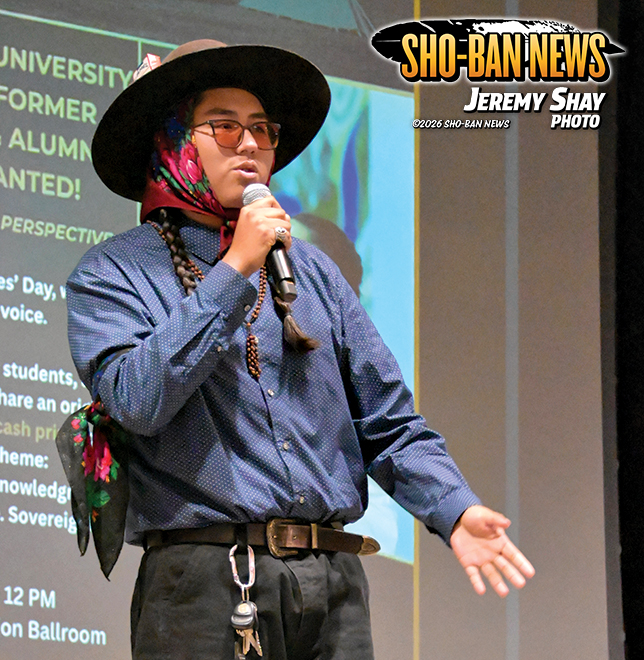
1st place oratorical speaker Darious Tillman, ISU student and Eastern Shoshone tribal member, speaks
to attendees on October 12.
By JEREMY SHAY
Sho-Ban News
POCATELLO — Several Native Idaho State University students and alumni competed in an oratorical competition at the ISU Indigenous Peoples Day event at the Pond Student Union Ballroom on Monday, October 12.
Various topics covering Indigenous perspectives and issues were discussed in a three to five-minute oratorical speech, each topic centered around the day’s theme, “Beyond the Land Acknowledgment: Indigenous Knowledge. Sovereignty in Action.”
The first place winner of the contest was ISU student Darious Tillman, from the Eastern Shoshone Tribe. In his speech, he talked about interpreting traditional teachings and its modern day application, using the history of Paiute leader Wovoka.
Tillman began by asking the audience two questions: “How many of you think the world is going to end soon? And how many of you know of a man named Wovoka?” he asked. “In 1889, on New Year’s Day, Wovoka fell into a coma, a near death experience, and he experienced a vision, he learned two things — to relearn compassion, to relearn our traditional teachings and compassion, and to practice non-violence. We take advantage of the fact that we get to come here and then go home safely, but in 1889, that was impossible. Some of you were just killed just because you look like an Indian — you were scalped, and your body was mutilated. When Wovoka went to all these different villages that endured massacres, they went through suffering beyond suffering — he said, ‘It's time to have hope, there's hope even through the most terrible suffering that we've gone through,’” said Tillman.
Darious went on to tie Wovoka’s message to today’s societal challenges Indigenous people are facing, “If you ask any environmental major, I think it's pretty clear that we're at the precipice of an ecological cataclysm. I don't want to freak anybody out, but look outside: we've got snow this year. And, I think it is clear that something is going to happen. A rebirth is going to happen. In our prophecies, in our traditions, we know that a rebirth is going to happen. How do you endure the incoming, impending cataclysm? The answer is simple, because look around, there's a bunch of Indians here, right? The genocide didn't work. It's hard to kill Indians, to keep them dead. Now, that's not a coincidence. The reason why this is, is because we have powerful teachings, powerful healing techniques that keep us alive,” he said. “As we are facing these challenges that we all are going to eventually have to confront, having these traditional teachings is going to be our only way through, that is the message I want to get out today.”
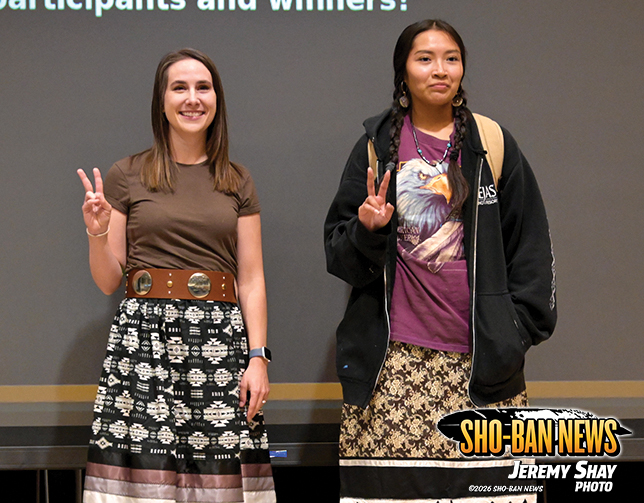
3rd place winner Rebecca Croy (left) and 2nd place winner Leelayla Tendoy.
In second place, Shoshone-Bannock tribal member and ISU student Leelayla Tendoy read a poem she had written about dismantling Christianity in Indigenous communities, and the harm religious denominations of non-Natives have caused throughout history, “I don't want to offend anyone, Christian denominations just have a pretty horrific history when it comes to Natives — boarding school era, Mormonism, Catholics, all that — it's not pretty. My belief is Christian denominations cause trauma more and more because it takes us away from our traditional roots. You take part in it — you're kind of conforming to the white men who wanted us to get rid of our Indian ways,” said Tendoy.
An excerpt from her poem was “You conquered our homelands, and then you call us addicts / We welcome to our home / We welcome you to our homes, and you call us fanatic / Colonizers, welcome to America / This is not your home, too / We can't do anything about it, but accepting for you / Compassion is key / Guilt is how you are set free / Remember, no afterlife can save me / from being afraid of time in this given life,” recited Tendoy.
She concluded her time by reiterating her message, “In my opinion, Christianity is just make-believe, it's a mythology. And they push that onto us, and made us stray away from our traditional beliefs — that's why I'm against it completely. I don't believe in owning land — land back is just the belief that we shouldn't own land, because Earth, in itself, is living. It's alive, and the idea of owning land is just inhumane to me because that teaches you that you got to own other living things, not just land. That's how slavery happens. That's how discrimination against women happens, because you believe you have to own something.”
Third place winner, Native ISU grad student Rebecca Croy, Potawatomi Nation, Bear Clan, spoke about moving “beyond the land acknowledgment” and her past experiences when advocating for more action in higher education to acknowledge Indigenous Peoples Day practices, and her ideas moving forward for the school.
Croy compared the land acknowledge step to that of an acknowledgment at the end of a book, “Land acknowledgments have a similar lack of impact — now, of course, there was a time when land acknowledgments were the important step, but they were only ever intended to be the first step in raising community consciousness about the native history of this place [ISU.] We bring questions before from the conversation like, whose land is this? But now we've already done this, faculty all across the campus have land acknowledgments at the end of their email, they are no longer new or conversation-starting. At this point, people have either chosen to engage with them or not, land acknowledgments have faded into the background,” she said. “Email signatures do not result in more land being returned to Indigenous peoples, they do not benefit Native students enrolling at ISU, or provide more monies available for research projects that benefit tribal communities — the land acknowledgments are just there. For you to read or not. And I think Indigenous Peoples Day, unfortunately, is also at risk of just being there.”
Croy spoke about past IPD events where ISU professors have deducted from her grades for missing classes on the holiday, “I'd like you to imagine an Indigenous Peoples Day that celebrates not just our music, dances, and of course presentations, but an opportunity for us to work together, to bring us into community and dialogue, to work, to improve the lives of Indigenous peoples, a day to educate staff and faculty who may be lacking cultural sensitivity.” Highlighting Native businesses, workshops that are community member-focused to address concerns, and making goals for each year, are some of the ideas Croy discussed.
“I want an Indigenous People's Day that is more than just a day of celebration, but it's a day we look back at all we've done in the past year, and all we can do moving forward.”
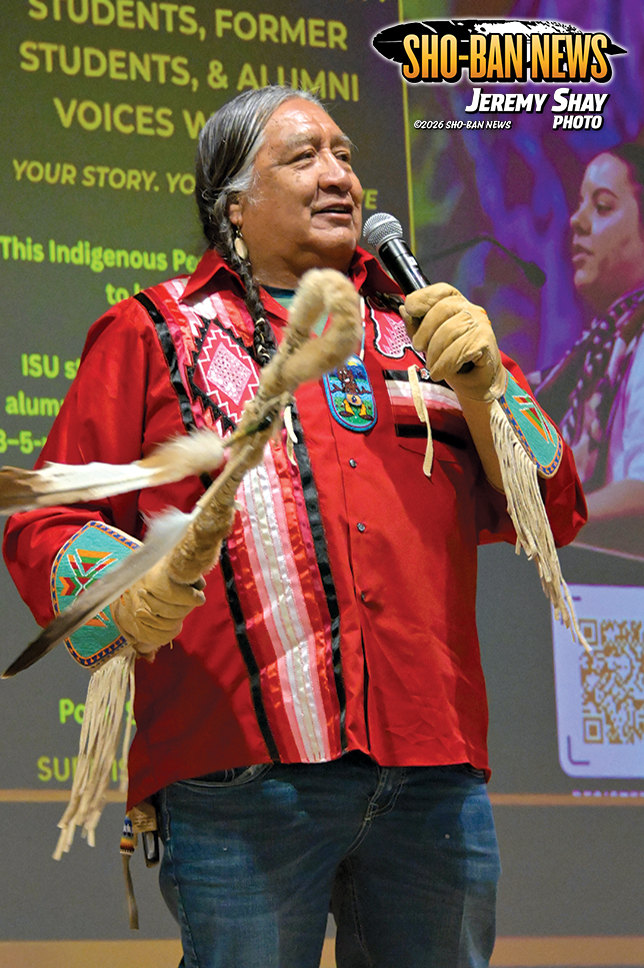
Fort Hall Business Council member and Sho-Ban tribal member Lee Juan Tendoy
speaks in the contest.
Among the other presenters were Diné ISU student Tyler Bellison spoke about his programs in engineering and physics and the importance of engaging tribal youth in STEM programs; Shoshone-Bannock tribal member presenters were Whitney Burns who spoke about medicine and public health, Lloyd George who spoke about his journey becoming a chef, Lee Juan Tendoy who spoke about his personal education history and the teachings passed onto him from his family, and Miss Native ISU Danella Perry Murphy spoke about her personal journey through education with her family’s support, and passing down ancestral knowledge to future generations.
Participants were evaluated by a panel of judges, with monetary awards given to each speaker, included grand prizes for first through third places — first place award to Darious Tillman was $300, second place Sho-Ban tribal member Leelayla Tendoy with $200 and third was Rebecca Croy with $100. Each participating contestant won a $50 consolation award.