IPD keynote speaker Gaylen Edmo addresses Shoshone-Bannock tribal sovereignty history
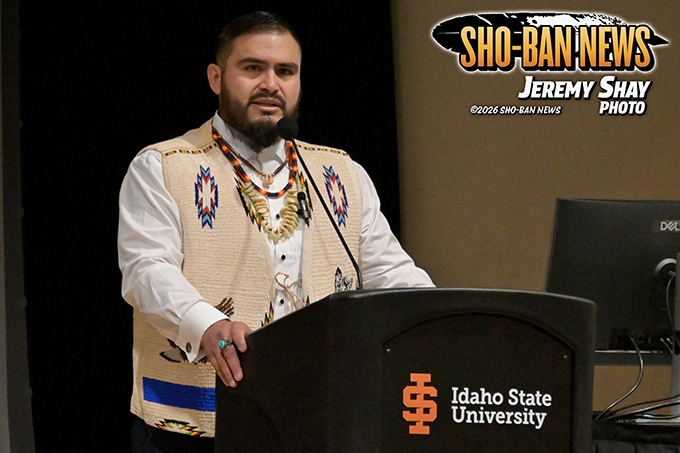
2026 ISU Indigenous Peoples Day keynote speaker Gaylen Edmo, Shoshone-Bannock Tribes assistant general counsel and tribal member, speaks at the event.
POCATELLO — Within federal law itself is a recognition of tribal sovereignty long held before the founding of the United States, before the Constitution was ever made and before the Treaty was signed.
“We were providing for our people and we were ensuring that future generations would continue to live as we have always lived,” Gaylen Edmo, Shoshone-Bannock general counsel said at the Idaho State University Indigenous Peoples Day event October 12 as he was keynote speaker.
He provided a definition of sovereignty from Black’s Law Dictionary that is broadly defined as supreme, absolute and uncontrollable power by which an independent state is governed, encompassing supreme political authority, paramount control over government and the constitution, international independence and accountability, free power to conduct internal and external state affairs – a baseline understanding of what it means in general.
“I think there are different definitions from different people. I think you have a different understanding of what tribal sovereignty means asking a lawyer versus a tribal leader. And I think both of their perspectives are valid,” he said. “But this says here, sovereignty is an expression of who we are the Shoshonean band. Sovereignty comes within our people, based on our culture and traditions. We exercise sovereignty in many ways by selecting our form of government, defining our membership, and negotiating with the United States. Each decision we, the Business Council, make or choose not to make is an exercise of our tribal sovereignty. That comes from my grandfather, (Kesley Edmo Sr.) who was chairman of our Tribes and council member off and on for 33 years, which is a really hard feat to do when we have two-year terms in tribal leadership.”
Gaylen’s background is specific to natural resources — Treaty hunting and fishing rights an area that falls in line with what his grandmother Maxine Racehorse Edmo told him. He remembers her telling him, “Before anything else we were hunters and we were warriors and don’t forget that and those are life ways that we carry on today and we will carry on in perpetuity but one thing that I want people to understand today is that the recognition of sovereignty is a right long-held.”
“And I want to stress that because that Treaty right that was signed by our people in 1868 goes far beyond those aspects in time, that timeframe, because the recognition of tribal sovereignty in the law pre-exists and pre-dates the creation of this country and the United States Constitution,” he continued. “And people need to understand that to be able to understand what exactly it means to be a tribal sovereign. Because the rights that we have as a tribe was not granted to us. The rights that we have as a tribe are granted from us. A reservation of rights not granted. And I know that is odd language to hear today and to try to understand, but that comes from an early 1900s case called the Winans case, which was a treaty rights case of the Yakima Nation and it has been consistently referred to and cited by the U.S. Supreme Court because of its recognition of tribal sovereignty and treaty rights.” “Now what does that mean, a right granted from the Indians is how it’s worded. That means that when our leaders sat down in negotiated treaty, we ceded certain rights to reserve a reservation, a permanent homeland for our people and for our tribal sovereign. But we also, under the reserved rights doctrine, reserved all rights not granted.”
He said he’s constantly learning but is thankful for the time he served on tribal council as the knowledge he gained there is because of that experience. There’s a historical document that tribal leadership had the foresight to put together in preparation for things including litigation. It talks about what leadership was to our people. “And within that document, it highlights the fact that we had what we’re referred to and still are today as Degwani. And day one, now that I understand that, is very powerful. Because we may have a Constitution today, we may have Bylaws, we may have what look like similarities to the federal government and even state government. But the history, the customs, and the traditions of our people really is what makes tribal sovereignty distinct and our history encapsulates all of that.” “So degwani means a boss or a leader in today’s terms. And in that document, it explains that some of the individuals that were looked to as paramount leaders within our tribes, like Taghee, who was one of the people that signed our Treaty. He was a skilled buffalo hunter. There were multiple people that were skilled – they were looked upon as leaders because they were skilled in a certain area of our lifeways. They led our people in seasonal rounds – the subsistence lifeways of our people as he referred to illustrations or displays the Language and Culture Preservation Department created. They include buffalo, bighorn sheep, salmon, camas bulbs, yamba, wild carrots - to us is what our life was centered around because back then the world was very much about survival and taking care of your people and subsistence and ensuring that you protected your people which is why it was a tribal way of life because it wasn’t just you taking care of yourself like today.”
He said today is very individualistic and it’s very much about your own family structure and taking care of that, “But my grandma used to talk about how we didn’t just take care of our individual families we provided for each other we hunted for the tribe, we took care of those who didn’t have hunters and we always provided for our people and that round illustration one part of the those buffalo degwani would be taking our people to go harvest buffalo and we would be taking care of that meat processing that meat drying it, preparing it for a trade gift and then another part of that year would be going to harvest salmon and hunt and fish salmon and doing the same with that and then another part of the year another degwani would lead our people specifically to the Camas Prairie and other areas where we could gather.”
It’s relevant to today, he said, because over 150 years after the Fort Bridger Treaty was signed (it’s not the only treaty our people signed) but the only ratified. He noted after 150 years our people are still here — we still have the rights that we held at that time except for those expressly granted. Our people are still carrying on what is referred to in the law as immemorial lifeways – a reference to time immemorial, antiquity (distant past). “That tribal way of life those rights that we had then are still here today and the immemorial life ways that our people served are still being practiced, and we still have to advocate for them day in and day out.”
Even though there’s what’s known as a trust responsibility from the United States government, owed and legally bestowed on the United States government, owed to the tribes, oftentimes you find yourself having to advocate in forums, even against them, telling them, hey, remember, you have a trust responsibility – it is a legal duty.
He explained throughout federal Indian policy there were eras including assimilation where the government took action because they believed Indians didn’t know enough – didn’t know what was good for themselves. They created boarding schools – kill the Indian save the man. Many of our people passed away there including children taken from families -indoctrination of a whole different form of life. They didn’t teach how to become a lawyer or scientist because they didn’t think our people had the ability to do that. They taught trades such as a farmer or seamstresses – institutionalized belittling of the capacity of our people misunderstanding our people came from a different way of life. But our people survived, we weren’t able to speak our languages at those places but our language survived. Our history survived.
“And it’s amazing and it’s humbling to be able to be asked to speak on what tribal sovereignty is today and what it is in practice. Because I am just a small little glimpse into a long history of the Shoshone and Bannock people,” Edmo continued. “And to be somebody who is a product of people throughout that time frame, throughout time immemorial, into the contemporary life that we live today, it’s amazing to see how resilient our people were, and how much foresight they had to reserve such important things for us.”
Litigation is also a form of external tribal sovereignty because we’re advocating for the rights and a legal forum of our people, he said. The right to hunt, to fish, the right to gather and graze they are viewed as priority rights of our people. An Idaho Supreme Court Case – the Tinno case where a tribal member was cited for spearing salmon on the Yankee Fork of the Salmon River – well within our homelands was an important case. The Tribes homelands are vast and expansive. Expert testimony was offered from our tribal people -the right to hunt means you’re going out to get food for your people, your family for subsistence, for survival. It’s not about sport – it’s taking care of our people -that’s the tribal way of life. He also talked about Swim v. Berglund a Ninth Circuit case about grazing on federal lands within areas that used to be the Fort Hall Reservation as laid out in the Treaty. There’s a right to graze under that Treaty right and the Forest Service recognized the right.
The significance our tribal people were able to preserve things, advocate and fight for the rights throughout history not only the negotiation of the Fort Bridger Treaty but today through litigation, tribal advocacy, through leaders going to Washington D.C. meeting with our agency decision makers because there’s a trust responsibility that needs to be upheld. And tribal sovereignty in action today, is very much illustrated in the day-to-day work life that tribal leadership lives.
Lori Ann Edmo contributed to this report.