Ruby Valley Treaty Conference presenters dissect traditional territory rights obstacles faced in Indigenous communities
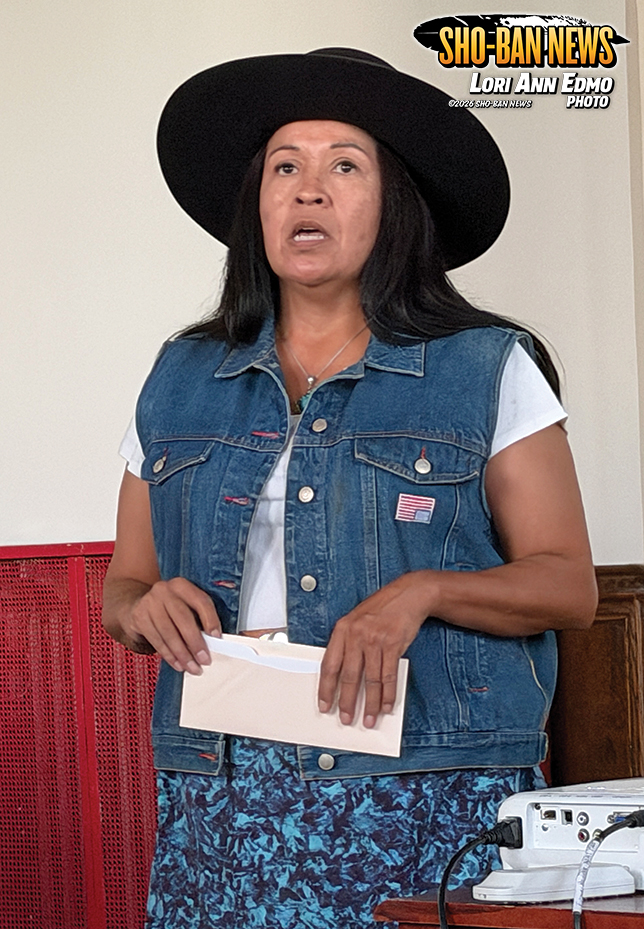
Noowuh Knowledge Center board of directors chairperson
Fermina Stevens speaks during a conference activity in
Elko, Nev. on October 1.
By LORI ANN EDMO
Sho-Ban News
ELKO, Nev. — The doctrine of discovery is an obstacle Indigenous people deal with every day as they fight for their right to self-determination and the right to defend traditional territories from destruction caused through mineral extraction, data collection and irresponsible water use.
Those are words Noowuh Knowledge Center Board of Directors Chairperson Fermina Stevens used to open the Ruby Valley Treaty Conference (RVTC) October 1.
Noowah Knowledge Center is a sister organization of the Western Shoshone Defense Project – an organization created by the Dann sisters Carrie and Mary (both deceased) who defended their land and rights. The RVTC goal is to provide education through information about history, treaty, land, water, legal, health, environmental justice, human rights issues etc.
The conference was four days with the first day focusing on dismantling the doctrine of discovery. The second day was about cultivating cultural lifeways while the third and fourth days focused on outdoor workshops at Lee, Nev.
Stevens explained doctrine of discovery origins were in Europe in the 15th century when empires supported religious authority — claims where Christian nations could take possession of lands occupied by people who are not Christian who they considered heathen. Religious authority was used to legitimize the taking of Indigenous lands giving the right to the domination and annihilation of Indigenous peoples. There were some Christians opposed to the violence and exploitation defending Indigenous humanity and rights – she said RVTC is not putting blame or pointing fingers at people of faith.
Stevens continued, “Today is telling the truth about how religious authority was used to justify colonization, and understanding how those ideas became embedded in political and legal systems that affect us today.” When the U.S. was created, the colonial concepts didn’t disappear, they became part of the legal structure of the new nation now called the United States. She gave the example of the 1823 Supreme Court decision Johnson B. McIntosh where the Supreme Court relied upon the doctrine of discovering describing the relationship between Indigenous land rights and a proclaimed title of the U.S. That decision became influential in what is now federal Indian law.
She explained the principles of Christian dominion were manipulated into legal principles and those principles were then used to structure agreements between the U.S. government and Indigenous nations. The ideas influenced the way courts and governments administered Indigenous lands. It influenced questions of sovereignty and treaty rights — who has the authority to make decisions about Indigenous territories. It created a legal system in which Indigenous peoples were repeatedly required to defend rights long before the U.S. existed. Stevens said the actions affected Indigenous people everywhere as the doctrine became a global system. As European colonization expanded across the world, the ideas traveled with them – they believed they had a superior right – a God given right to determine what happens to Indigenous lands. The impact was in the Americas, Africa, Australia, New Zealand and other parts of the world. Lands were declared unoccupied and available. Traditional governments and leaders were dismissed, cultures described as inferior, tribal spirituality was attacked. Newe were removed from their homelands and life sources taken. It wasn’t accidental, it was a system. Once it’s understood, one can understand why the doctrine of discovery matters today.
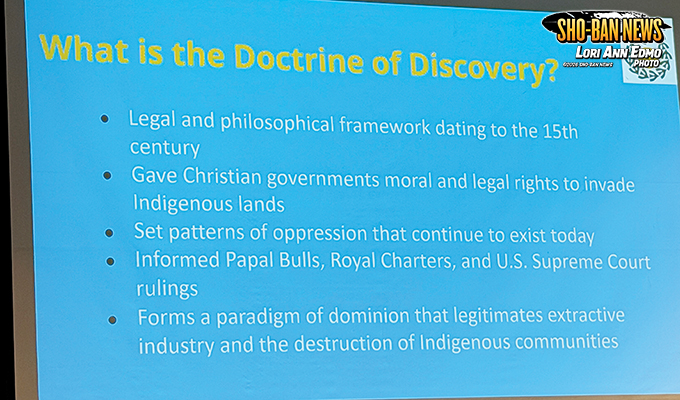
Presentation slide shown to Ruby Valley Treaty Conference attendees about the Doctrine of Discovery at Great Basin College in Elko, Nev.
Sarah Augustine gave the keynote address talking about how she cofounded the Coalition to Dismantle the Doctrine of Discovery. They are organizing people across North America especially in the U.S. and Canada to join a social movement. The doctrine is a body of laws and policies the Supreme Court adopted in 1823. The doctrine is a body for making law and policy so there are thousands of laws based on the doctrine of discovery. Slavery was one and segregation. The doctrine of discovery is a paradigm (pattern) that shapes every institution. The Supreme Court is impacted, judiciary, government, corporations, schools. Decolonization is grounded in Indigenous knowledge and lifeways. She explained how Christianity was used to go into lands and take everything. That is why their coalition to dismantle the doctrine of discovery primarily organizes Christians. They intend to take time to train folks, to get them to work on campaigns to change laws and policies especially as it pertains to Indigenous peoples.
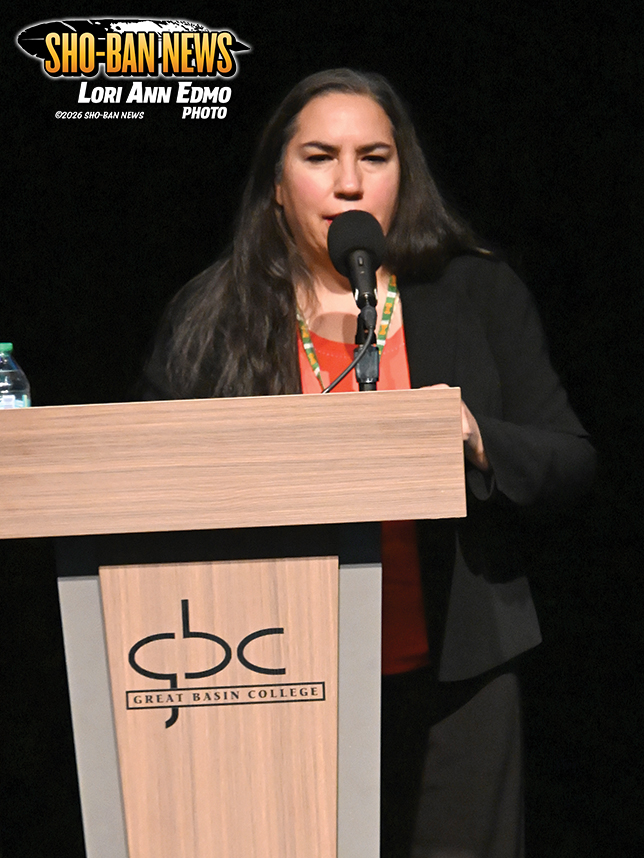
Sarah Augustine speaks.
Tina Ngata, Ngati Porou Nation, New Zealand, spoke via Zoom about the Doctrines of Domination and Systems of Racism. She explained the sense of supremacy and entitlement started in the 14th Century. They believed they were more sacred, closer to God because they were descendants of St. Peter and imposed it on people of other lands. The tapestries from the 14th century depicting the Crusades, Jesus leading armed forces holding the Bible blessed by St. Michael with his divine mandate to violently enter and carry out the deeds of war without mortal consequence. She said within 100 years characters such as King Alphonso, Portugal, Pope Nicholas, took the entitlements from the Crusades and applied them in West Africa so they could enter into slave trade. Pope Nicholas gave them a series of paper laws to invade, search out, capture, vanquish and subdue all Saracens, the word for Muslim and pagans. Pagans were viewed as enemies of Christ. Indigenous people were referred to as pagans.
Ngati believes colonization was the root of assimilation – colonizers believed they were doing Indigenous people justice to remove Nativeness, educate it out. “So within those people builds, we see the priority of profit, we see disregard for Native life. We see the suggestion of inherent European supremacy. The entitlement to remove the sacred from Indigenous peoples, to set up systems of extraction,” she continued. “And to use your power and your privilege to protect your right to extract. And then you will treat these people as children, and that you know better. And so I can easily take away those words, doctrine and discovery, and replace it with U.S. government, and it would make sense, right? Because the U.S. government, I could actually take those words out and replace it with New Zealand government. I could take those words out, replace them with Australian government, and that’s because, if I come back to my key point, can learn your nation building, is actually based upon the features of the doctrine of discovery.” She added, “It’s not based upon what I would say, you know, any kind of constitutional values. And I would argue it’s not based upon the values, even in the Declaration of Independence. It’s based upon the values of the doctrine of discovery, applied to all peoples. Now as this moves around the world, it becomes a shared language of extraction. And nations would become, essentially, whole entire continents would become extraction zones. And when it gets to this extent, you know, it becomes a shared language globally, a set of assumptions over a couple of 100 years, it comes a set of assumptions. And there are very few places where those ideas were not embedded as the basis of the governance systems of that place. “
Ngata said merchant groups including East India Company, Hudson’s Bay Company, New England Company, South Sea Company were the beginnings of corporation building what a global economic empire might look like.
She said what’s being done to our people is not new it goes back hundreds of years but our stories and our survival go back hundreds of years and our duty, which is a sacred duty to remember, the pain of the story, the lives that have been sacrificed at the hands of conquistadors, hands of companies and governments, the pain – the pain is also a duty and a pathway to our liberation.