American Indian Treaties & hunting rights discussed at Museum of the Rockies United States 250 panel
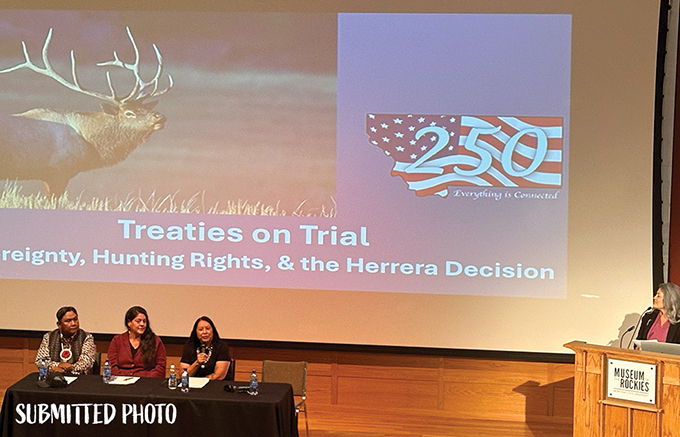
“American Indian Treaties: The Supreme Law of the Land — Herrera v. Wyoming” panelists at the Museum of the Rockies in Bozeman, Mont. on July 24.
By YVETTE TOWERSAP
BOZEMAN, Mont. — As the United States commemorates its 250th anniversary in 2026, a panel discussion at the Museum of the Rockies highlighted an often-overlooked part of American history: treaties between the United States and American Indian tribes.
The Museum hosted “American Indian Treaties: The Supreme Law of the Land — Herrera v. Wyoming” on Friday, July 24, in Bozeman.
Panelists included Heather Whiteman Runs Him, a former Native American Rights Fund attorney; Jeanette Wolfley, a former Shoshone-Bannock Tribes attorney; and Clint Wagon, former chairman of the Eastern Shoshone Tribe. Meredith Hecker, director of Native American Studies at Montana State University, moderated the discussion.
The panel emphasized that treaties are not simply historical documents. They remain legally binding agreements between sovereign tribal nations and the United States and continue to shape relationships among tribes and federal and state governments.
Wolfley explained that Article VI of the U.S. Constitution recognizes treaties as part of the supreme law of the land. “That means treaties are superior to state constitutions, they’re superior to state law, and they are, in fact, equal to federal law.” She emphasized that treaties carry significant legal weight and continue to test the United States’ commitment to good faith, its treaty obligations, and the rule of law.
Whiteman Runs Him discussed Crow treaty rights and the legal challenges surrounding Herrera v. Wyoming. In 2019, the U.S. Supreme Court ruled that the Crow Tribe’s off-reservation hunting right under the 1868 Treaty of Fort Laramie did not end when Wyoming became a state.
“At the end of the day, our people are still hunters, and we’ll still continue to seek access to those resources,” she said, adding that tribal members should be able to exercise treaty rights without fear of being cited, fined, or imprisoned.
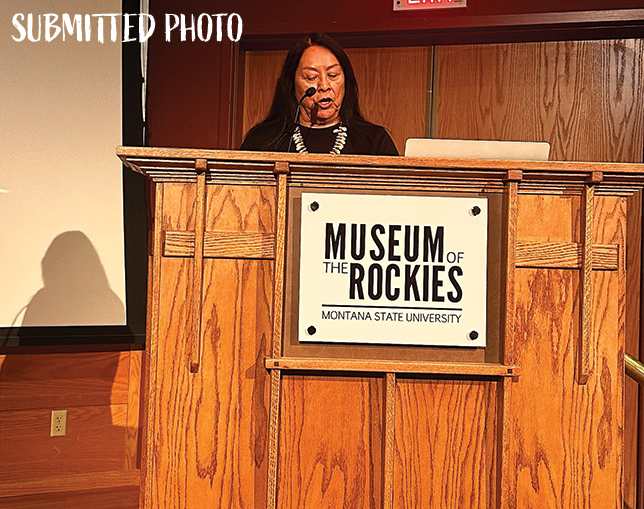
Shoshone-Bannock tribal member and former SBT attorney Jeanette Wolfley speaks.
Wagon discussed the importance of treaty and hunting rights to the Eastern Shoshone Tribe and the responsibility to pass hunting traditions to future generations. “We have different beliefs, different traditions, different languages, but we all want our kids to know our hunting traditions,” Wagon said.
The panel demonstrated that although the Crow, Eastern Shoshone, and Shoshone-Bannock Tribes have distinct histories and treaty relationships, they share a commitment to protecting treaty hunting rights and cultural traditions. The tribes also share a commitment to ensuring state and federal governments understand and respect those rights.
Numerous Crow tribal members attended, including members of Clayvin Herrera’s family, Crow Tribal legislators, and Crow Fish and Game staff. Scholars from the University of Waikato in New Zealand also attended as part of an Indigenous knowledge-sharing summit.
As Americans reflect on 250 years of national history, the panel offered an important reminder: American Indian treaties are part of the nation’s constitutional and political history, and the promises contained within them remain relevant today.