FHBC tours reservation rangelands to assess grazing, restoration & long-term land health
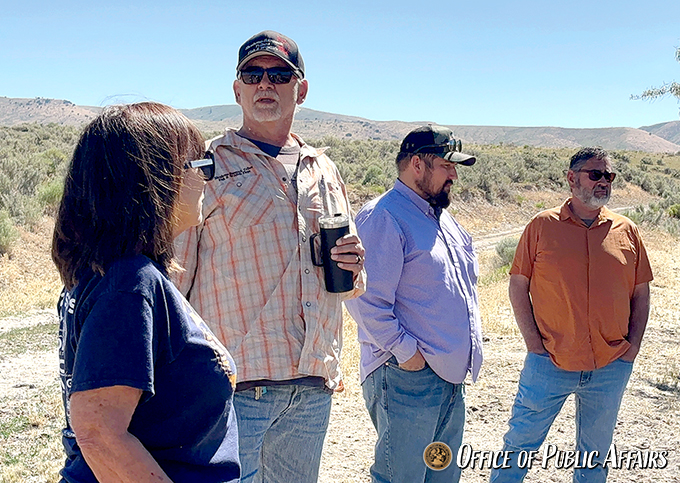
Fort Hall Business Council members and tribal staff on the rangelands tour in the Lincoln Creek District on the Fort Hall Reservation June 18.
By ROSELYNN YAZZIE
Office of Public Affairs
FORT HALL — The Fort Hall Business Council toured several rangeland areas across the Fort Hall Reservation on June 18 to assess current grazing conditions, restoration needs, and long-term stewardship priorities.
Council members visited range units on the northern part of the reservation as part of the tour, following an earlier June 3 visit to the Arbon Valley area where non-grazed lands were observed for comparison. Together, the visits provided a broad view of range conditions and management challenges across the reservation.
Land Use Director Preston Buckskin said the tour was intended to give council members a firsthand perspective for ongoing discussions about grazing and natural resource management.
“We wanted them to see where Land Use, Natural Resources, and permittees are coming from when we’re talking about the rangelands and the importance of these resources,” Buckskin said.
He added that the effort also aimed to strengthen communication between tribal leadership, landowners, permittees, and resource managers, while supporting informed decision-making on long-term land use.
Staff from Land Use, Water Resources, Fish & Wildlife, and Fish & Game provided updates on drought conditions, invasive species, watershed health, wildlife habitat, and ongoing restoration efforts. Discussions emphasized the need to balance livestock grazing with protection of sensitive ecological and cultural resources.
During the tour, staff discussed a proposal to defer approximately 1,200 acres in the Lincoln Creek area to improve the ability to restore the landscape. The goal is to improve rangeland conditions for livestock while enhancing habitat for native wildlife species such as elk, mule deer, and sage grouse. Several groups of elk were observed during the tour, showing the importance of these areas for wildlife.
Fish and Wildlife Director Chad Colter also spoke about sage grouse conservation, including long term monitoring of active leks and the need to protect and improve habitat conditions that support sage grouse populations on the reservation. His comments highlighted the Fish and Wildlife Department's role in wildlife management and habitat conservation.
Staff described a larger pilot project spanning 10,000 to 15,000 acres of burned rangeland aimed at evaluating long-term restoration strategies such as reseeding, grazing deferment, and vegetation recovery methods.
Water quality was a topic of concern, particularly at Cold Creek in the Lincoln Creek area. Water Resources engineer Candon Tanaka discussed monitoring efforts that have documented elevated E. coli levels in several mountain streams and the factors contributing to those conditions. This highlighted the connection between rangeland management and water quality, including how livestock use, wildlife use, road systems, and riparian conditions can influence stream health and water quality.
Staff talked about how improved grazing management, travel management planning, riparian restoration, and coordinated watershed management can help protect water quality while improving habitat conditions for fish and wildlife.
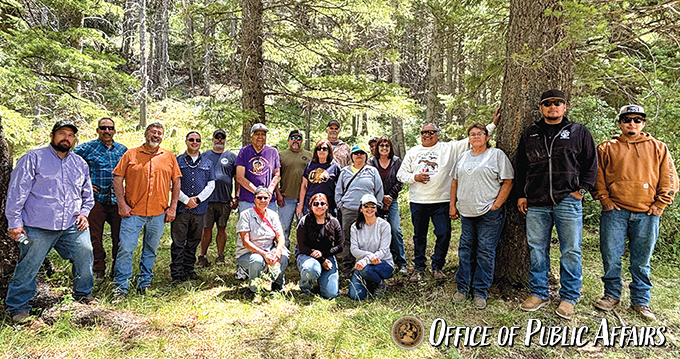
FHBC members and tribal staff on the tour on June 18.
The Fort Hall Reservation includes approximately 326,000 acres of rangeland divided into 14 grazing units. Ten units remain active, while four are deferred due to drought conditions or conservation management needs.
Chairwoman Donna Thompson said the tour was helpful in understanding current conditions on the ground.
“I’ve been to these areas before, but since I’ve been on Council this was the first time I got to see these areas in this way and really see what’s going on,” Thompson said. “Hearing directly from staff and seeing the conditions firsthand provided valuable insight.”
Buckskin explained successful rangeland management requires balancing multiple needs across the reservation.
“Our goal is to ensure tribal cattle producers can continue to graze, landowners continue to benefit from the use of their lands, and our natural resources remain healthy and productive,” he said. “Ultimately, we have a responsibility to protect, promote, and enhance our reservation and its resources for future generations.”
A key theme that emerged throughout the day was the interconnectedness of grazing management, wildlife conservation, watershed health, travel management, wildfire, and post-fire recovery. The tour demonstrated how decisions in one area can influence outcomes in another and showcased the collaborative approach among departments and commissions working together to evaluate resource conditions, discuss challenges, and explore opportunities to improve the long-term health of tribal lands, waters, wildlife, and rangelands.
Natural Resources Division Deputy Executive Director Lytle Denny said, “The Division is working to strengthen collaboration across departments to better address these complex natural resource challenges.”