Land Use continues Mormon cricket monitoring
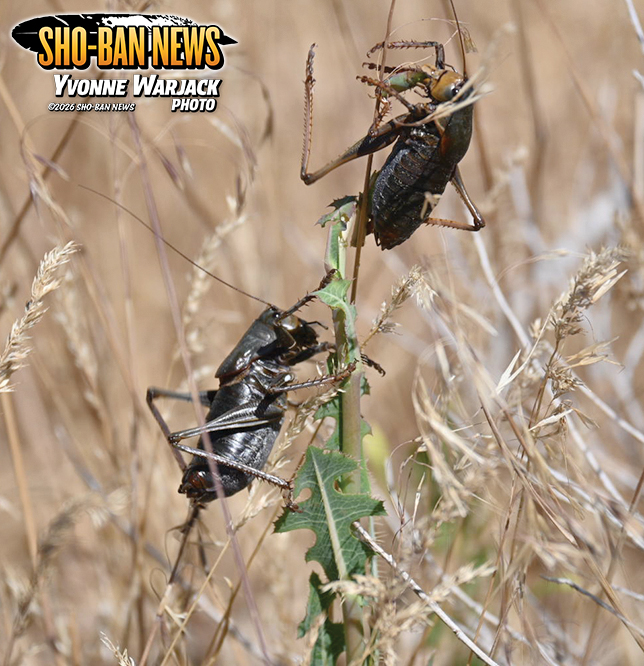
Mormon crickets seen on the Fort Hall Indian Reservation.
FORT HALL — The Shoshone Bannock Tribes' Land Use Department continues to monitor Mormon cricket activity across the Fort Hall Reservation while coordinating with state and federal partners to protect Tribal rangelands and agricultural resources.
Mormon crickets are a native insect found throughout the western United States. During outbreak years, their populations can increase rapidly, forming large bands that move across the landscape in search of food. Large infestations can consume grasses, forbs, crops, and other vegetation, reducing forage available for livestock and wildlife and impacting the health of Tribal rangelands. They are also a food sources for many native species according to a press release.
Earlier this spring, the Land Use Department began coordinating with the Idaho State Department of Agriculture and the United States Department of Agriculture Animal and Plant Health Inspection Service to assess infestations and implement treatment where appropriate.
To date, treatment activities have been completed in several areas of the Reservation. Initial treatments were conducted on May 4 in Garden Creek, Cold Creek, White Rocks Road, and Buckskin Basin. Other treatments were completed on June 8 in the Big Springs to Bennetts Pass area and a second treatment was completed on portions of White Rocks Road near Thompson Farms, and below Ross Fork Cemetery.
Current treatments utilize Canterbury bait, a carbaryl based bran bait that targets Mormon crickets. Operational guidelines limit treatment of an individual area to no more than two applications during a season, with treatments separated by approximately 14 days to allow sufficient time to evaluate treatment effectiveness before additional applications are considered.
Land Use staff continue conducting field surveys to monitor existing infestations and identify new areas of concern. During a recent range tour, staff observed Mormon cricket activity in portions of Buckskin Basin, Lincoln Creek, Dry Hollow, Gay Mine, Lone Pine, and Big Springs. Follow up surveys are planned to verify infestation levels, evaluate movement patterns, and determine whether additional treatment is warranted. Additional areas currently being evaluated for treatment include Lincoln Creek, Lone Pine, the Narrows, and Big Springs.
"Our goal is to respond quickly while making informed decisions," said Preston Buckskin, Director of the Land Use Department. "Protecting our rangelands is important to our livestock producers, wildlife, and the Reservation as a whole. We are working closely with our agency partners to make sure our response is based on sound information, field observations, and the best management practices available."
Kameryn Farmer, who coordinates the Department's field response, said monitoring conditions on the ground is essential to determining when and where treatment is needed.
"We don't simply treat every area where crickets are reported," Farmer said. "Our crews conduct field surveys to determine the size of the infestation, how the population is moving, and whether treatment is warranted. That information helps us prioritize our response and use treatments where they will be most effective."
"We continue to monitor treated areas throughout the season to evaluate how well the treatments are working," he said. "At the same time, we're working with the Idaho State Department of Agriculture and USDA APHIS to better understand treatment effectiveness, environmental considerations, and how we can continue improving our management approach."
The Land Use Department is also evaluating the long-term effectiveness and ecological implications of current treatment methods. Future discussions with agency partners will focus on treatment effectiveness, potential impacts to wildlife and other natural resources, and opportunities to incorporate additional management approaches into future response efforts.
The Land Use Department will continue monitoring Mormon cricket activity throughout the summer and coordinating with agency partners as conditions change. Community members who observe significant Mormon cricket activity are encouraged to contact the Land Use Department ARM program office at 208-478-3878 or 478-3907 so infestations can be documented and evaluated.
Farmer said residents being affected can purchase a chemical called Seven that can be purchased at C-A-L Ranch, Lowe’s or Home Depot as it protects grass and flowers.
Protecting Tribal lands requires ongoing stewardship, collaboration, and adaptive management. Through continued monitoring and partnerships with state and federal agencies, the Land Use Department remains committed to protecting the Reservation's rangelands while ensuring management decisions reflect the long-term interests of the Shoshone Bannock Tribes.