Fort Hall Business Council & Sho-Ban Tribes representatives attend Tribal Self-Governance health conference in Arizona
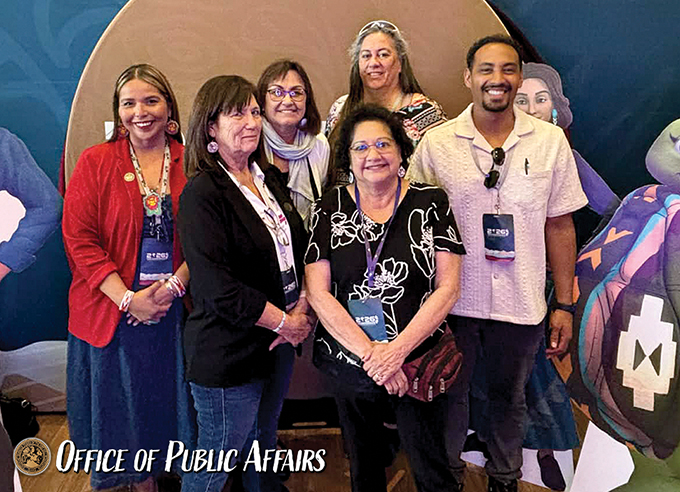
Shoshone-Bannock Tribes representatives at the Tribal Self-Governance Conference.
By ROSELYNN YAZZIE
Office of Public Affairs
CHANDLER, Ariz. — Representatives from the Shoshone-Bannock Tribes attended the Tribal Self-Governance Conference on April 7 to 9 at the Gila River Resort.
Participation was made possible through the Tribal Self Governance Negotiations Cooperative Agreement Grant and provided an opportunity to learn from and engage with other tribal nations on issues impacting self-governance and community well-being.
Attendees included Fort Hall Business Council Chairwoman Donna Thompson, Executive Director Laverne Sheppard, and Tribal Health staff Travis Martin, Norma Wadsworth, and Kathe Christensen.
The conference brought together tribal leaders, health administrators, and federal partners to discuss the continued growth of tribal self-governance and the ways tribes are strengthening their ability to design and manage programs that strengthen sovereignty and improve the delivery of services to their people.
Sessions explored a wide range of topics, including the role of emerging technologies and the importance of developing policies around data stewardship, privacy, and cultural protection. Discussions emphasized that tribes are at different stages in addressing these issues in ways that align with their values, priorities, and sovereignty.
Updates were given from federal agencies, including a Department of Transportation update highlighted Assistant Secretary James Crawford’s commitment to advancing Tribal self-governance and strengthening partnerships with tribal nations. He emphasized efforts to expand sovereignty within transportation systems and increase departmental capacity to better serve Indian Country.
U.S. Health and Human Services Secretary Robert F. Kennedy Jr.
speaks
at the Tribal Self-Governance Conference.
Key priorities included safety campaign initiatives, integration of human trafficking prevention efforts, and addressing workforce challenges such as air traffic controller shortages in both air and ground operations. Crawford also discussed opportunities to incorporate tribal input in transportation planning to ensure solutions reflect community needs.
He noted ongoing collaboration with the Bureau of Indian Education (BIE) to develop pathways for students interested in aviation and airspace careers, with a focus on expanding opportunities for tribal youth. He emphasized continued engagement with tribes and the importance of shaping the future of self-governance in transportation through partnership and dialogue.
During a plenary session, U.S. Department of Health and Human Services Secretary Robert F. Kennedy Jr. reaffirmed the federal government’s trust responsibility to provide health care to American Indian and Alaska Native communities. He emphasized that this responsibility remains a top priority and highlighted efforts to strengthen tribal health systems through direct engagement, accountability, and partnership.
The Secretary noted his extensive outreach to tribal nations over the past year, including visits to more tribal communities than any previous HHS Secretary. He said these visits have informed a more responsive approach grounded in listening to tribal leaders, health administrators, and community members.
He further highlighted the expansion of tribal self-governance in health care, noting that more than 60 percent of the Indian Health Service budget is now administered by tribes. He also pointed to historic investments in health funding, infrastructure modernization efforts, and the ongoing transition toward more locally controlled, culturally appropriate care systems.
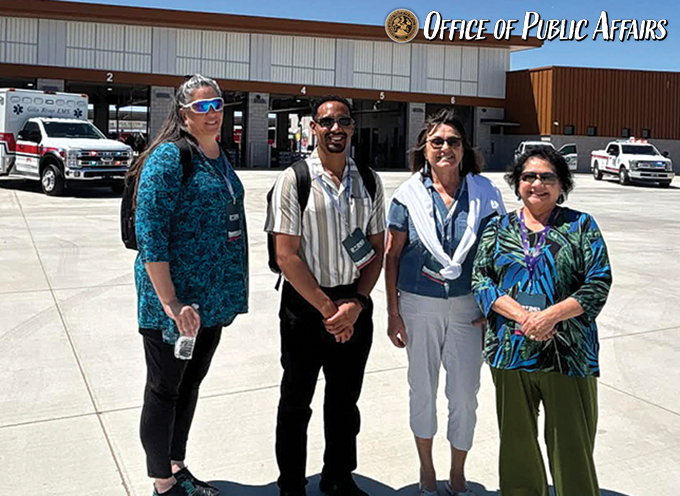
Sho-Ban Tribes representatives visit the new Gila River Public Safety building.
While in attendance, representatives toured facilities within the Gila River Indian Community, including a public safety building and the Gila River Health Care facility developed through self-governance efforts. The public safety building brings police, fire, and emergency management services together in one facility to improve coordination and response times. The health care facility demonstrated expanded services, workforce development efforts, and the use of multiple funding sources to support community needs.
At the ribbon cutting for the public safety facility, Governor Steven Roe Lewis noted the project had been in development for two years and emphasized its importance to community safety.
“Combining our emergency responders in this location, we will cut down on emergency response time for members of our community who need immediate assistance. Sometimes life and death calls,” Lewis said.
He added that the facility strengthens the ability of emergency responders to serve across the Tribe’s approximately 372,000-acre land base.
Chairwoman Donna Thompson reflected on the experience, stating, “This conference provided an opportunity to learn how other tribes are approaching Tribal Self Governance while remaining grounded in their values. As these conversations continue throughout Indian Country, it is important our focus remains on listening to our membership, staying informed, and asking critical questions to ensure the priorities and protections of our people are upheld.”
Overall, the conference provided an opportunity to observe how tribal nations are navigating both longstanding and emerging challenges while continuing to strengthen self-governance.