‘Healing With Water’ central theme for 23rd Annual Grief Conference
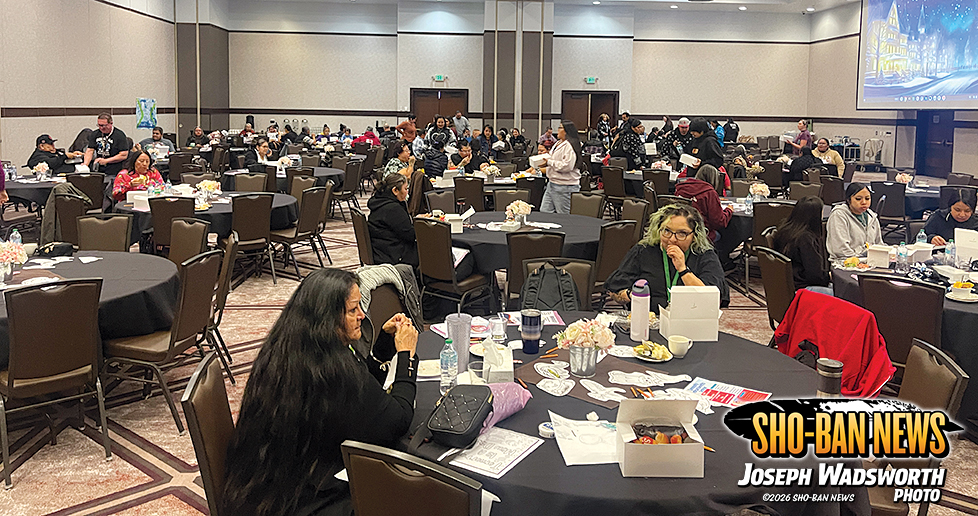
Attendees at the 23rd Annual Grief Conference at the Sho-Ban Casino Hotel Events Center on Monday, March 16.
By LORI ANN EDMO
Sho-Ban News
FORT HALL — Healing With Water is the theme for the 23rd Annual Grief Conference March 16 and 17 – Travis Martin, Shoshone-Bannock Tribal Health and Human Services director, said there’s so much water does for us.
“It’s important that our ancestors taught us that we respect water, pray for water and provide water into our lives,” he continued. Presenters and activities helped attendees with healing such as ice breakers, along with crafts projects.
Lee Juan Tyler, Fort Hall Business Council vice chairman, sang a water song and said the opening prayer.
Personal experience
Jason Butler, Waapi Kani Mental Wellness and Recovery Services manager, talked about the chronic health process in relationship to grief. He shared his own personal experience about losing family members to chronic illness noting it’s a slow process taking place over a number of years. He also spoke about his diabetes diagnosis at age 21 and how he had a poor attitude believing the disease will kill him anyway. He had that attitude for a long time, “It took me down this rabbit hole of depression. I lived that life for a long time. It took many, many years of that. When I look at the stages of grief, you kind of go through that whole process while you’re doing that.” The stages of grief include shock, denial, anger, bargaining, depression, testing, acceptance going through all the different stages. Butler said he started to use alcohol then became depressed getting stuck there a lot of years.
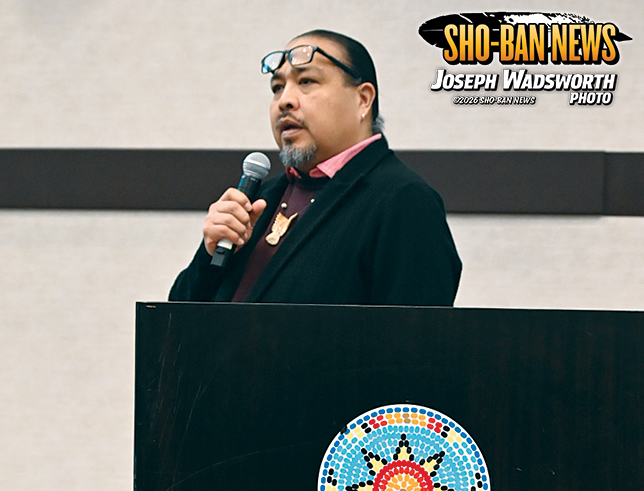
Behavioral Health manager Jason Butler speaks at the Grief Conference.
By that time, he became very sick, but he found a new life. “Almost like a rebirth,” seeing the world in a different way. He started to realize how beautiful life is – that’s his life today. His life in recovery enables him to see nature and have moments of clarity. A year after recovery he lost sight in his right eye but after surgery, he’s able to see again. One of the things the doctors found is he has kidney disease. He’s accepted it. He was told he had a choice to make – do what the doctor said to keep off dialysis or keep living the way he was. For seven years he did as he was told but about two years ago his kidney function dropped more. The doctor said he needed a kidney transplant or dialysis. With acceptance he found certain things were taken from him as used to participate in Sundance but can’t do it anymore so he had to reframe his mind. Instead of Sundance, he was able to sing but after a year, his kidney function dropped more and he was exhausted. So, he just attended the Sundance and listened, closed his eyes, switched his mindset.
“Never once in my life have I ever just gone there and sat there and prayed for everybody. And I opened my eyes and I looked around and I was like, this is the most coolest thing ever. I’ve never done this in my life,” he continued. Now he attends powwows to watch his wife and aunt dance. Previously he would be sitting at the drum at powwows thinking of songs and doing whatever. “What I realized was that I was being given a new opportunity to live and to experience and to grow and to learn. And that’s what life is about, right? It’s about growing, it’s about learning.” He believes it’s important to be honest especially with family members – have conversations about what you’re going through. He’s on dialysis but is hoping for a kidney transplant. Maybe your family members are going through chronic illness but I’m here to tell you that it’s okay – it’s okay to talk about it, he said.
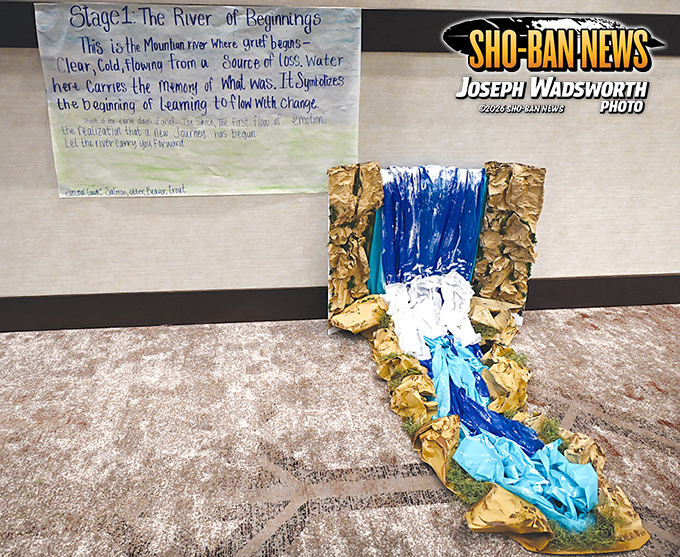
“The River of Beginnings” diorama of river water flowing, part of the conference theme.
Respect in passing of loved one
Bingham County Coroner James “Jimmy” Roberts followed with a “Honoring our Loved Ones” PowerPoint presentation. His goal is to make certain every person his office cares for is treated with respect, dignity, compassion and the highest level of professionalism possible. His team is committed to serving all residents and visitors of Bingham County including Indigenous families with sensitivity and care. He said his office has developed a respectful guide to reduce the stress and trauma faced by loss created in partnership with Waapi Kani Mental Wellness and Recovery Services. It helps navigate practical matters after a death while honoring cultural beliefs.
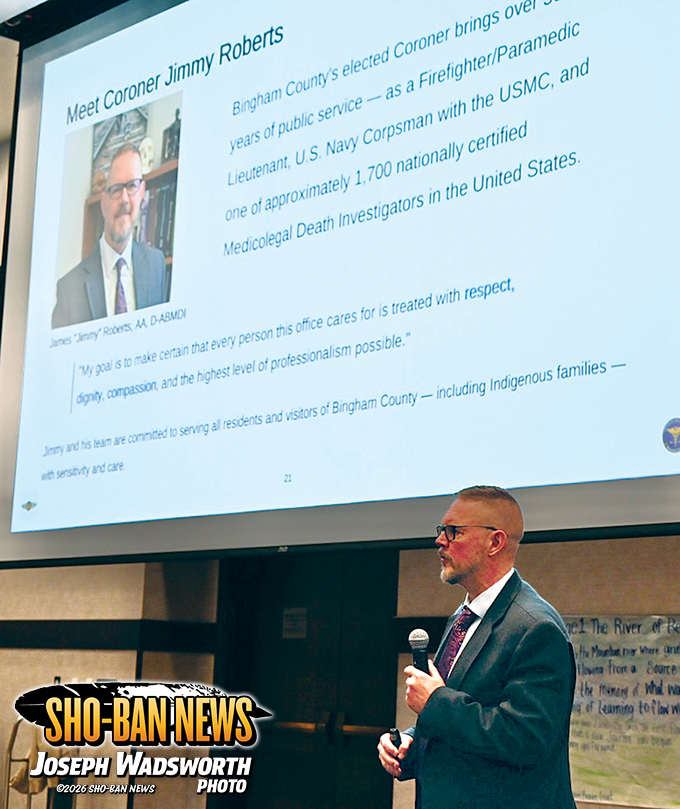
Bingham County Coroner Jimmy Roberts speaks to Grief Conference attendees.
Traditional protocol consultation and requests are welcomed including having the right to gather, sing and practice traditions. It’s important to let the coroner know how they can support or align services to be supportive in the transition of loved ones. If one hasn’t yet received a death certificate, contact the coroner’s office to request a confirmation of death letter that is accepted by insurance companies and other organization. Legal next-of-kin or durable power of attorney may request autopsy or forensic inspection reports by calling 208-782-3040 or visit the Bingham County coroner website. Reports with pending criminal charges wont be released until 45 days after sentencing.
Idaho law requires the coroner to investigate sudden, unexpected, unattended or suspicious death - any death that may be a concern for public safety. The coroner’s office helps to confirm identity, determine cause and manner of death, along with support family with information and compassion. Their office works independently from law enforcement, has authority to order an autopsy or forensic testing, releases the body to the funeral home and answers questions about medical findings. Law enforcement focuses on public safety and criminal investigation as the may secure the scene and collect evidence. They hold personal property collected as evidence. They have separate authority and separate chain of command.
Understanding the steps – contact the coroner, choose a funeral home, director guides, request documents. The funeral director becomes a primary guide for arrangements while the coroner’s office answers questions about cause and manner of death. Tribal specific consultation comes from respective tribes for questions on culture and supportive services.
Who can make decisions?
The coroner’s office follows Idaho law: Active duty/DOD designation – person listed in military emergency data records. Durable power of attorney for healthcare – must specifically authorize funeral and burial decisions. Surviving spouse – even if separated but not divorced. Adult children, parents, siblings – majority agreement required when more than one person in a category. Court appointed representative – personal representative of the estate or next degree of kinship under Idaho law. A close friend or significant other cannot legally authorize arrangements unless they hold a valid Durable Power of Attorney for Healthcare.
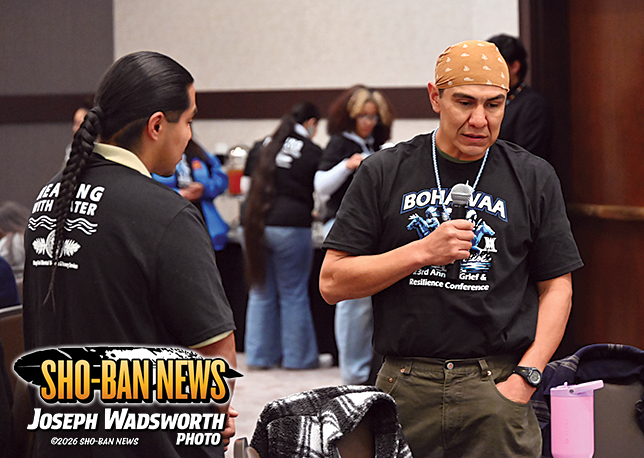
Colton Teton speaks about grief during the conference.
Roberts provided information on burial assistance including Bingham County Indigent Services for county residents who cannot cover funeral or cremation costs can apply for financial assistant contact 208-785-3097. Bureau of Indian Affairs – Financial Assistance and Social Services provides burial assistance for deceased indigent Indians whose estates cannot cover funeral expenses. VA Burial Benefits (Veterans) – families of American Indian Alaska Native veterans may qualify for grave opening, perpetual care, headstone or marker, burial flag and presidential certificate at no cost. A downloadable guide listing tribal burial assistance programs by tribe and state is available at ncuih.org
Concerning loved ones medications, investigators collect all medications to review, count and assess compliance as part of understanding cause of death. If medications are found, contact the investigator immediately and have the bottles with you. Do not discard or flush medications. The coroner’s office handles safe, environmentally responsible disposal for protecting other and the water supply.
To get help with grief contact Waapi Kani (Cedar House) at 208-478-4026 and the crisis line is 208-238-4000. Tribal Victim Assistance Program contact 208-478-3992 and Shoshone-Bannock Social Services 208-478-3898.
After lunch a memorial grief slideshow was shown followed by a presentation from Dr. Anderson of Portneuf Cancer Center.
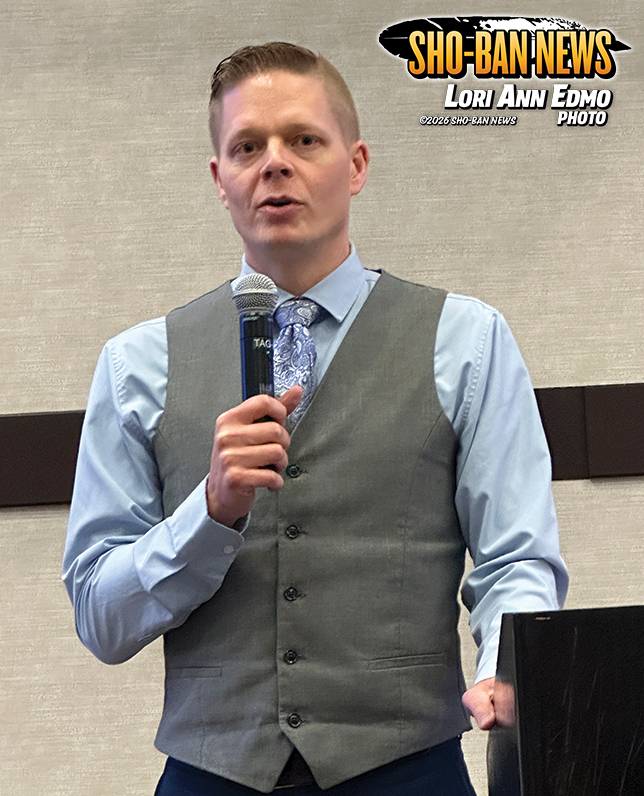
Portneuf Cancer Center’s Dr. Anderson presents.
The Carrying the Message MMIW and MMIP group did a presentation. Willeena George said they stick together as a group and lean on each other when something happens. They’ve had three missing loved ones found and that is the hardest part. They pray and be strong for one another.
Susan Pevo talked about her son Austin who went missing in February 2018 and was found in April 2020. Her grief comes from the love for her son. She’s turned to family for support and gone to family counseling to help with grief. She started doing ceremonies to help with healing. She also does beading as a form of therapy. She honored her son through dancing and that was her last step of healing.
Daeda Pevo spoke about her involvement with Carrying the Message group as they do walks and protest. One hundred percent of what they do is through prayer.
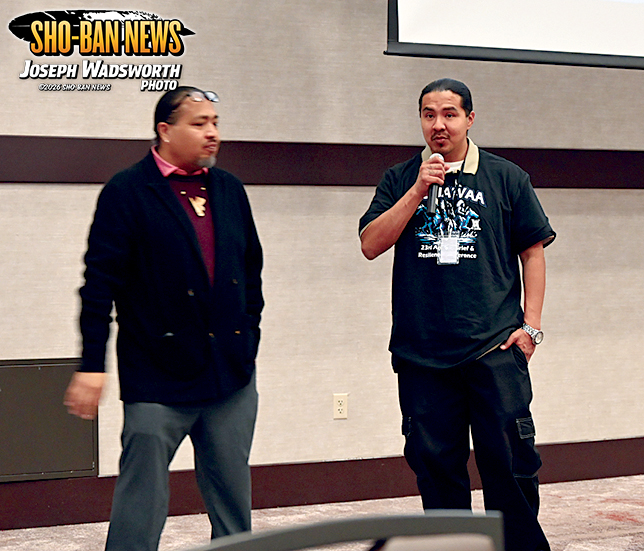
A Recovery Coach speaks at the annual Grief Conference.
Cynthia Cinder Metz talked about her son Matthew Broncho when he went missing in March of 2019 and he was missing for over five years. Family and friends searched extensively for him near Snowville, Utah and at home. During those times she said she was emotionally drained and coping with possibly losing her son. She connected with the MMIP group and they supported her when she was feeling emotionally drained and confused. She felt frustration from the lack of assistance from law enforcement after persistently requesting further investigation into his disappearance and the hindrance of jurisdiction issue. After meeting with the local MMIP and various grassroots groups throughout the Northwest, “For the first time I was able to express my feelings and hear what other problems were happening in theory in the cases that involved their missing and murdered loved ones. Hearing the obstacles and painful emotions they endured helped me cope with what I needed to do as a mother,” she said and helped her to never give up. During the years, not knowing where or what happened to her son she prayed everyday he would be okay wherever he was. She said she had to push on for her family. His remains were found near Snowville in April of 2024 and he was brought home in May of that year. “I was in shock and disbelief.” She’s thankful to her family, the support of the group and the community.
Willow Abrahamson discussed Navigating the Waters of Grief afterward followed by a make and take activity of rock painting.
Lemuel Stone did the closing prayer for the day.